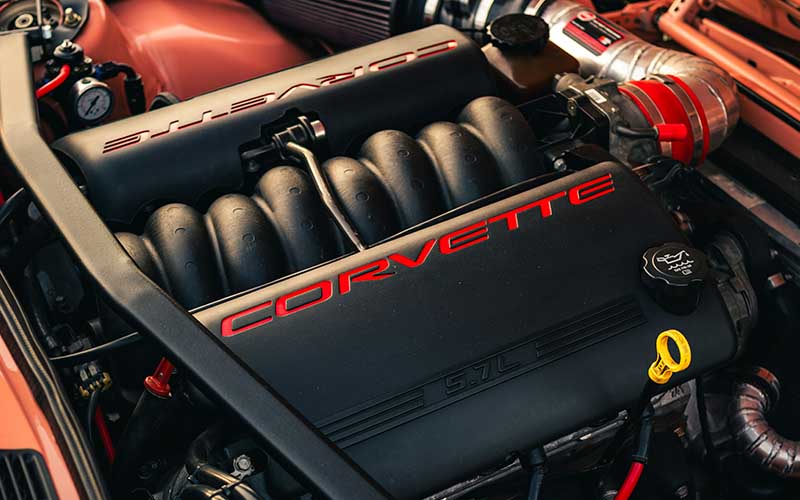
The Chevrolet Corvette has long been associated with powerful V8 engines, dramatic acceleration, and unmistakable American performance. For decades, the V8 has been at the heart of the Corvette’s identity. However, the automotive industry is changing, with manufacturers increasingly turning to smaller engines, turbocharging, hybrid technology, and improved efficiency. This raises an interesting question: how does a six-cylinder engine compare with the traditional eight-cylinder powerplant in a Chevrolet Corvette?
Although the Corvette has historically relied on V8 engines, comparing six- and eight-cylinder configurations helps illustrate the fundamental differences between engine size, performance, efficiency, and driving character.
The Traditional Corvette V8
The V8 engine is arguably one of the most important features of the Chevrolet Corvette. From early small-block engines to modern overhead-valve V8s, Chevrolet has continually developed the formula to produce impressive power while maintaining relatively compact dimensions.
A V8 engine has eight cylinders arranged in two banks of four. Compared with a six-cylinder engine, it generally offers greater displacement and more potential for producing high horsepower and torque. In a Corvette, this translates into rapid acceleration, strong high-speed performance, and an engine character that has become central to the car’s appeal.
Modern Corvette V8s demonstrate how far this technology has evolved. The naturally aspirated 6.2-liter V8 used in the Corvette Stingray produces substantial power without relying on turbochargers. Higher-performance versions add technologies such as flat-plane crankshafts, more aggressive engine tuning, and increased airflow to achieve even greater performance.
One of the major advantages of the V8 is its broad torque curve. The engine can produce significant torque across a wide range of engine speeds, making the Corvette feel powerful not only when accelerating from a standstill but also when overtaking at higher speeds.
What Would a Corvette Six-Cylinder Offer?
A six-cylinder engine has two fewer cylinders than a V8, but that does not necessarily mean it would be slow. Modern turbocharging and hybrid technology can allow smaller engines to produce remarkable amounts of power.
A six-cylinder engine can be configured in several ways, including an inline-six or V6. A turbocharged six-cylinder could potentially deliver performance comparable to an older or less highly tuned V8 while using less fuel under certain conditions. Reducing the number of cylinders can also lower engine weight, potentially improving the vehicle’s balance.
For a mid-engine sports car such as the modern Corvette, weight distribution is particularly important. A lighter engine could contribute to sharper handling and quicker responses during cornering. However, the actual effect would depend on the engine’s design, placement, cooling requirements, and supporting systems.
The biggest difference would probably be the engine’s character. A six-cylinder engine can sound and feel exciting, particularly at high rpm, but it would not necessarily deliver the same deep, unmistakable V8 sound associated with the Corvette.
Performance Comparison
When comparing six- and eight-cylinder engines, cylinder count alone does not determine performance. Displacement, forced induction, compression ratio, engine speed, hybrid assistance, and tuning all have major effects.
A naturally aspirated V8 has the advantage of delivering power in a very linear and predictable way. Pressing the accelerator produces an immediate response, and the engine’s increasing intensity as the revs rise is an important part of the driving experience.
A turbocharged six-cylinder could potentially compensate for its smaller displacement by forcing more air into the engine. This can result in very strong torque and impressive acceleration. However, turbocharging can introduce additional complexity and, depending on the design, a different throttle response compared with a naturally aspirated engine.
For enthusiasts, therefore, the question is not simply which engine is faster. It is also about how the power is delivered.
Efficiency and Weight
The six-cylinder configuration has another potential advantage: efficiency. With fewer cylinders and potentially smaller displacement, a six-cylinder engine can consume less fuel, particularly when combined with modern cylinder management, turbocharging, or electrification.
Weight is also important. Removing two cylinders can potentially reduce engine mass, although turbochargers, intercoolers, hybrid components, and other equipment can offset some of those savings.
The V8, meanwhile, remains attractive because Chevrolet has decades of experience optimizing its architecture. Modern V8s can incorporate sophisticated fuel-management and emissions technologies while still producing extraordinary performance.
Which Engine Is Better for a Corvette?
The answer depends on what the driver values most.
A six-cylinder Corvette could appeal to drivers who prioritize efficiency, lower weight, and modern powertrain technology. With turbocharging or hybrid assistance, such an engine could still provide extremely strong acceleration and potentially offer a more economical alternative.
The V8, however, remains difficult to replace from an enthusiast’s perspective. Its sound, torque delivery, mechanical character, and connection to Corvette history make it more than simply a source of horsepower. For many drivers, the V8 is part of what makes a Corvette a Corvette.
Ultimately, a six-cylinder engine could be technically capable of delivering excellent sports-car performance, but the V8 offers a combination of performance and emotional appeal that has defined the Corvette for generations. As automotive technology continues to evolve, the Corvette may experiment with different powertrain solutions, but the V8’s place in its history—and in the hearts of many enthusiasts—is unlikely to disappear anytime soon.